
Know Your Process in Real Time: the ultraDAWN Pilot Detector and Inline RT-DLS

Dan Some, PhD.
Senior Principal Product Manager
Waters Technologies announces two new capabilities for inline/online process analytical technology (PAT) in downstream bioprocess. These advancements extend real-time multi-angle light scattering (RT-MALS) integration from bench scale to pilot-scale unit operations and add nanoparticle sizing by real-time dynamic light scattering (RT-DLS) in-line with the process stream.
Why process analytical technology, and why now?
Biopharmaceutical development is costly and time-intensive by nature. A single downstream process development (PD) run can cost tens to hundreds of thousands of dollars, and final optimization may require a dozen such runs or more. Batch failures in manufacturing cost more still. Across gene therapies, vaccines, and therapeutic proteins, the same bottleneck appears at every scale: process development lags and production yield suffers because key product attributes, including critical quality attributes, are only measured hours to days after the process run is complete.
For process development, fraction collection intervals are not small relative to the process duration, potentially missing critical events, and there is always concern that the samples may undergo degradation by the time they undergo offline characterization. For production, inherent process variability may lead to reduced yield (in order to ensure quality) or lost batches (when taking risks to maximizing yield). Furthermore, regulatory expectations under ICH Q8/Q10 and the FDA's PAT initiative have long called for measurement during manufacturing, yet deployment of true inline and online PAT for biophysical attributes has lagged behind the ambition.
For biophysical product attributes such as molecular weight, nanoparticle size, physical titer and full capsid ratio, RT-MALS and RT-DLS close those gaps. By placing a plug-and-play, bench-scale ultraDAWN or skid-scale ultraDAWN Pilot RT-MALS Detector directly inline with the process flow or online with continuous sampling, process solutions are monitored up to five times per second, with no sample handling and no waiting. CQAs, discrimination between product and impurities, aggregate detection, column loading and breakthrough, actual eluting titers or empty/full separation, depolymerization, or conjugation endpoints are identified and quantified immediately, reducing offline analytics along with their resulting costs in reagents and consumables, sample handling, chain-of-custody paperwork and potential for reporting errors.

What's new: Pilot scale RT-MALS and RT-DLS in the process stream
At the bench scale, RT-MALS may be integrated inline, typically with preparative chromatography, mRNA-LNP encapsulation and similar processes, or online (where an auxiliary pump draws solution to the ultraDAWN Detector), typically with UF/DF and various reactor or mixing/blending vessels. While scale-up of the online configuration is usually straightforward, a solution for scale-up of inline RT-MALS beyond bench scale was missing. The ultraDAWN Pilot Detector brings inline RT-MALS to the higher flow rates encountered during scale-up.
In addition to RT-MALS, DLS provides complementary biophysical data – hydrodynamic nanoparticle size and polydispersity. A DLS detection module may be embedded in an ultraDAWN or ultraDAWN Pilot RT-MALS Detector. However, unlike MALS, DLS is highly sensitive to flow and can only be measured accurately under very low flow or, preferably, stop-flow. We now offer several solutions for implementing RT-DLS via online and inline process integration, providing process development and PAT scientists with powerful tools for optimizing, monitoring and controlling downstream bioprocess.
Together, these additions make RT-MALS an essential PAT platform from lab to plant.
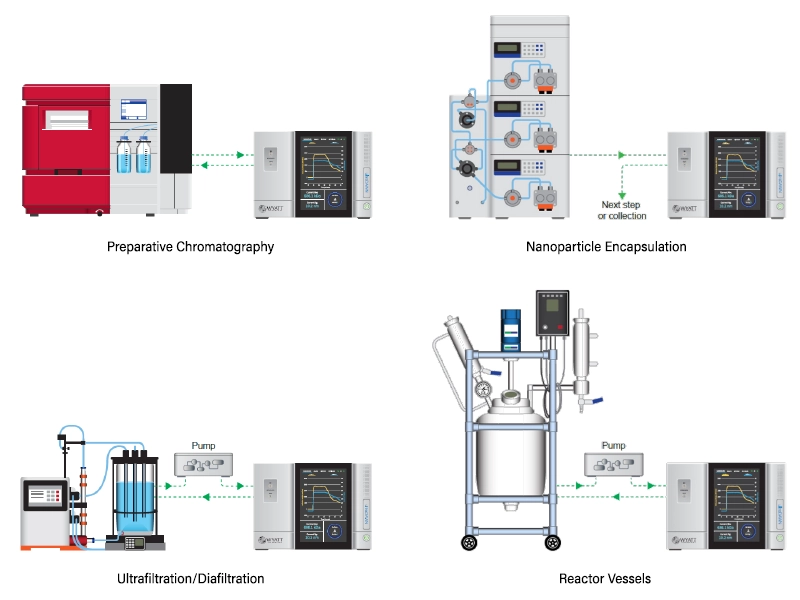
RT-MALS instrumentation couples inline or online to downstream unit operations such as preparative chromatography, ultrafiltration/dialfiltration, nanoparticle encapsulation and reactor vessels
Light Scattering for the Masses™: Example applications
| Process unit operation | Modality | RT-MALS / RT-DLS output |
|---|---|---|
| Chromatographic full-capsid enrichment | AAV | Quantify empty and full titer, %full capsid, in flow-through, and eluant; quantify pool content in real time; detect column overloading/ breakthrough; detect eluting aggregate
|
| Chromatographic polishing (flow-through) | mAb | Real-time % high-molecular-weight species; confirms aggregate removal and breakthrough
|
| Chromatographic purification | LVV, AdV | Quantify physical titer, radius, polydispersity; detect column breakthrough; confirm virus content and titer in eluting peak; detect eluting aggregates
|
| Chromatographic purification | EV | Detect EV ‘ghost peak’ in eluant, invisible to UV
|
| Ultrafiltration/diafiltration (TFF) | LVV, AdV, AAV, mAb, LNP | Titer and aggregation monitoring through concentration and buffer exchange; membrane fouling detection via permeate-line sampling
|
| LNP-RNA formulation/encapsulation | LNP-mRNA | Particle size, polydispersity, and physical titer
|
| Polysaccharide depolymerization/conjugation | PCV | Molar mass or size endpoint detection in real time; eliminates model- and time-based process endpoints
|
| Disassembly/assembly | VLP, IVT | Monitor size or MW to confirm process behavior and detect endpoint
|
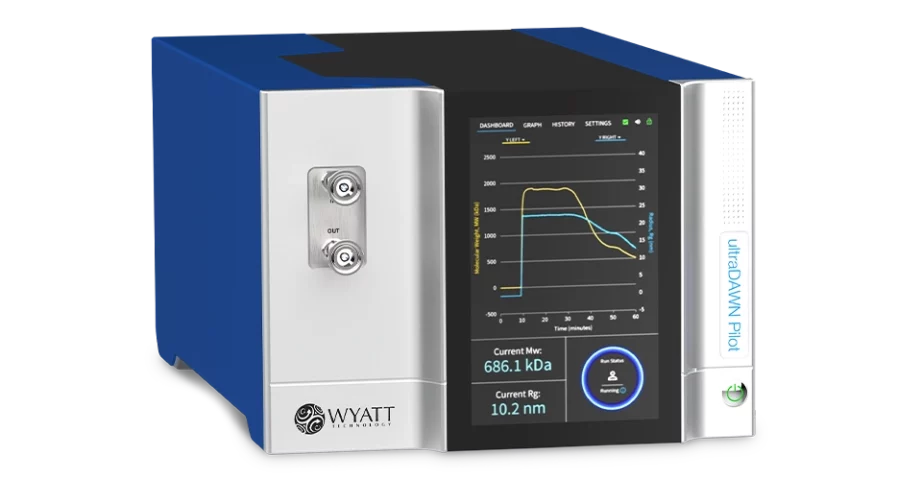
ultraDAWN Pilot RT-MALS Detector at preparative and pilot scale
After successful process development at the bench scale aided by RT-MALS, the question arises as to how to proceed with scale-up. If the ultraDAWN Detector is configured for online sampling, the same configuration can usually continue to pilot scale. However, this will not generally be true when the ultraDAWN Detector is configured in line with the process. The standard ultraDAWN Detector supports inline process flows up to 150 mL/min (or ~2 L/min with a splitter), 1/16” PEEK tubing and 10-32 fittings, and is optimal for bench-scale purification, but is not suited to pilot-scale process flows and fluidic hardware.
The ultraDAWN Pilot Detector resolves this directly. The instrument shares the same operating principles and electro-optical system as the standard ultraDAWN Detector, but is equipped with a larger diameter flow path and tri-clamp sanitary fittings that are customary at the pilot scale. It supports inline process flows up to 1 L/min, extendable to 15 L/min with a passive splitter, and so covers most needs for scaled-up process development and even production scale for many pertinent modalities in cell and gene therapy or vaccines.
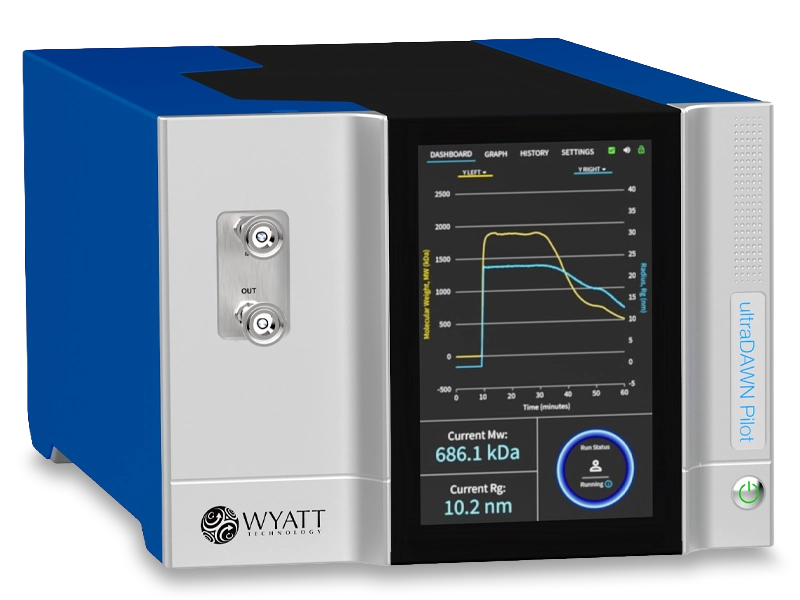
ultraDAWN Pilot Real-Time MALS Detector
New RT-DLS for particle sizing directly in the process stream
Dynamic light scattering is the go-to technique for measuring hydrodynamic radius (Rh) and polydispersity (PDI). A DLS module can be embedded in ultraDAWN and ultraDAWN Pilot Detectors to monitor Rh and PDI in real time (RT-DLS), enabling detection of size changes during RNA-LNP encapsulation, tracking aggregation onset during UF/DF, or confirming depth filter integrity. However, since DLS is sensitive to flow, care must be taken to ensure appropriate measurement conditions. OBSERVER Software offers two DLS measurement modes:
Continuous mode
In continuous RT-DLS, the sample must pass through the ultraDAWN Detector at low flow rate (ultraDAWN Detector: typically ≤1 mL/min for macromolecules, ≤0.3 mL/min for nanoparticles; ultraDAWN Pilot Detector: at least 10x higher flow rates are feasible). MALS and DLS data are acquired simultaneously. This mode is viable in the online configuration where a pump draws a small slipstream from the process to the detector.
Periodic stop-flow mode
DLS is best measured without flow, providing the maximum size range and most stable results. OBSERVER Software supports two periodic stop-flow modes: inline and online. In both, MALS data are collected during flow while DLS data are acquired while flow stops. The interval and duration are fully configurable, and periods as short as 10 seconds are feasible.
In online periodic stop-flow, a pump under control of OBSERVER Software draws solution from the process to the RT-MALS detector (at any flow rate of which the pump is capable) and is periodically paused for DLS measurement. For the inline configuration, where the entire process stream (or a sizable fraction of it) flows through the ultraDAWN Detector, OBSERVER Software operates a three-way Orbit™ Valve to periodically bypass the detector, thus pausing flow of the sample fraction in the flow cell for DLS measurement.
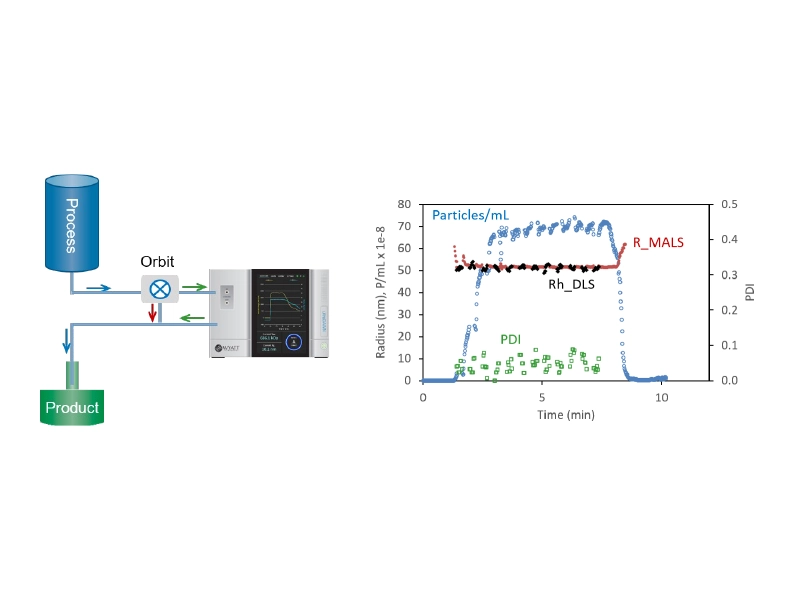
Nanoparticle size, concentration, and polydispersity monitoring by RT-MALS/DLS with periodic stop-flow. R_MALS is the geometric radius, Rh_DLS the hydrodynamic radius, PDI the polydispersity from DLS, and Particles/mL the particle concentration from MALS.
Across these workflows, the RT-MALS return on investment is consistent:
- In process development, a single ultraDAWN Detector replaces multiple rounds of offline fraction analysis per PD run, provides deep process characterization, reduces the number of iterations, and compresses development timelines.
- In commercial production, an ultraDAWN Detector can improve yield and quality, potentially saving bad batches.
Interested in exploring further?
Request a consultation and on-site demo at
Request a consultationLearn more about RT-MALS and RT-DLS instrumentation and applications, and access on-demand webinars and downloadable application notes at
wyatt.com/RT-MALS wyatt.com/ultraDAWN wyatt.com/OBSERVER