
A simpler path to high-performance field-flow fractionation

Nemal Gobalasingham, PhD. Principal Product Manager
As we mark the 60th anniversary of field flow fractionation (FFF) this year, it’s a moment to reflect on decades of innovation—and to look ahead at how FFF continues to evolve. In our latest blog, A simpler path to high performance field flow fractionation, we explore how guided workflows, starter methods, titanium channels, and Arc Premier integration are redefining what it means to run FFF—bringing greater simplicity, consistency, and confidence to one of the most powerful separation techniques available.
Field‑flow fractionation (FFF) was introduced 60 years ago as a fundamentally different approach to separation1 — one that avoids stationary phases and instead uses an external field to gently fractionate macromolecules and particles by their physical properties.
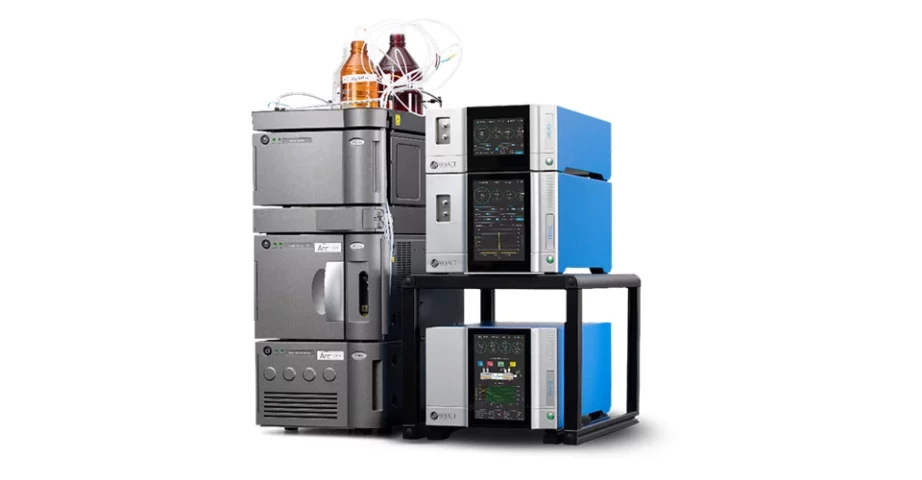
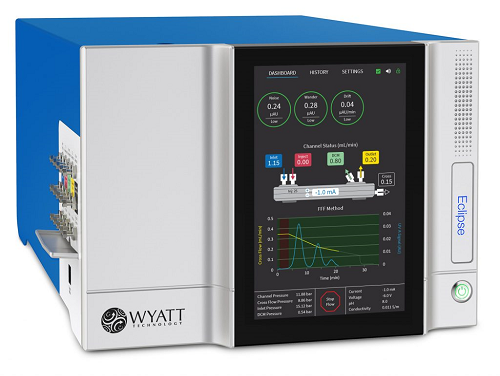
Today, asymmetric-flow field‑flow fractionation (AF4) is the most widely used implementation, valued for its ability to deliver high‑resolution, size‑based separations while minimizing shear and unwanted interactions. The Eclipse™ FFF system leads the way as the world’s most advanced and capable fractionation system.
Light Scattering for the Masses™: Why simplicity matters in FFF
Field-flow fractionation (FFF) is one of the most powerful separation techniques available, particularly for complex biomolecules, nanoparticles, and emerging modalities such as LNPs and viral vectors. Its adoption in biopharma continues to accelerate—from supporting FDA approval of the first generic cyclosporine ophthalmic emulsions2 to inclusion in United States Pharmacopeia general chapters <1154> for liposomal drug products and <1153> for drug products containing nanomaterials3.
“AF4 has shown that it can detect subtle changes in manufacturing that other techniques miss—differences that are directly linked to product quality and safety. … Another application where AF4 shows advantages over SEC is in the case of LNPs and extracellular vesicles. It offers a broader fractionation range and better reproducibility across different formulations. This is especially useful when particle surface chemistry or size changes are subtle, allowing these differences to be tracked without compromising stability.”
—Alina Astefanei, Assistant Professor in Analytical Chemistry, University of Amsterdam4
To fully realize these benefits, it is essential to make high-performance FFF easier to implement, easier to run, and easier to reproduce. This focus defines a simpler path forward—reducing complexity at every stage of the workflow. Software-guided workflows replace manual guesswork, starter methods accelerate time to first results, and tight integration with the Waters Arc Premier HPLC system streamlines operation. Combined with new titanium fixed-height channels, including a simplified dispersion inlet option, these advances make high-performance FFF more accessible—accelerating adoption while improving reproducibility and confidence in analytical development.
Guided workflows that reduce manual steps and guesswork
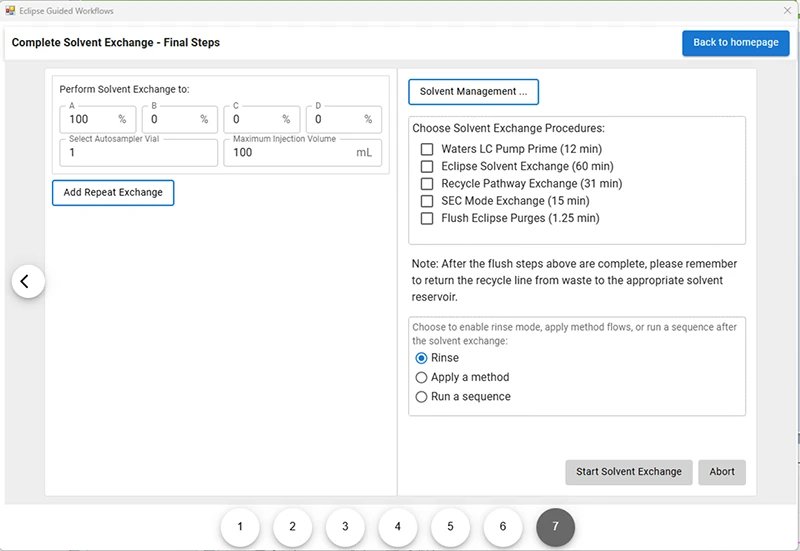
System preparation can be one of the more time-consuming aspects of FFF, particularly when it comes to solvent exchange and system cleaning. Guided Workflows in VISION™ software 4.2 are designed to change that.
Instead of navigating multi-step procedures manually, users are guided through an intuitive workflow that consolidates decisions, validates inputs, and automates execution. Solvent exchange steps that once required constant attention can now be completed with minimal intervention—whether repeating exchanges, flushing the system, or transitioning directly into sequence execution. By reducing manual steps and guesswork, Guided Workflows make solvent exchange faster, more consistent, and far more hands-off—helping teams move from preparation to ready-to-run with confidence.
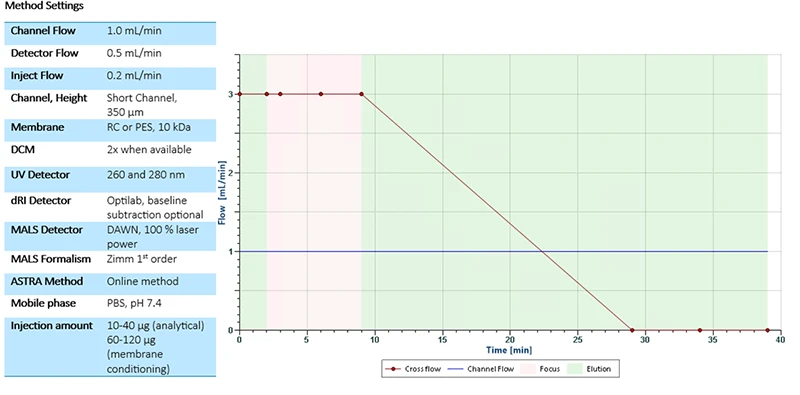
Starter methods further simplify adoption by reducing the barrier to entry. Developed as practical, application-ready starting points, these methods capture proven configurations for biomacromolecules, gene delivery vehicles, and nanoparticles—removing much of the trial-and-error that traditionally slows early experiments or simulations. These can be run immediately and provide guidance for sample preparation, MALS analysis, and other parameters. Combined with ASTRA™ software’s 40 years of innovation in MALS analyses, the result is faster time to first separation, greater confidence in early data, and a more intuitive path from method selection to successful execution—especially for teams new to FFF or expanding into new sample types.
Titanium fixed-height channels with Arc Premier support for robustness and reproducibility
Consistency in FFF starts with the channel itself. The introduction of titanium fixed-height channels brings a more robust, predictable foundation to separations through new design improvements—increasing the reproducibility of retention time with mechanical stability, extending concentration enhancement with the Dilution Control Module™ (DCM) up to 10x without loss of resolution, and providing excellent chemical- and biocompatibility.
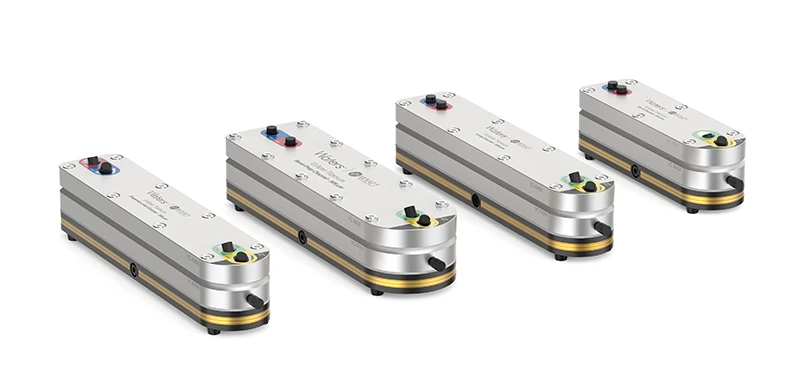
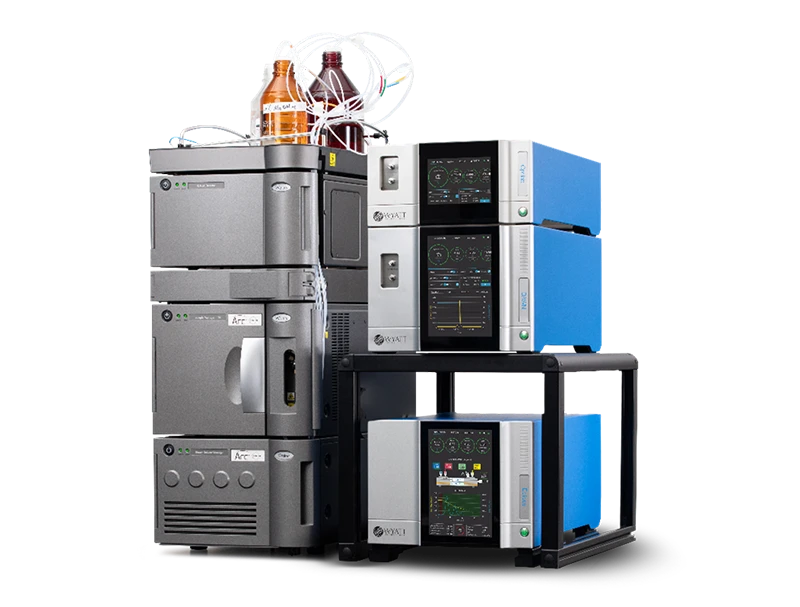
When paired with native support for Waters Arc Premier, the result is a more cohesive system experience, where separation hardware and LC operation work together as a single, integrated workflow.
This combination removes friction at the interface between FFF and LC, helping simplify setup, execution, and operation. Instead of managing complexity across multiple components, users gain a more streamlined path to high-performance FFF—built on hardware designed for reliability and software integration designed for ease of use.
Fixed-height dispersion-inlet channels: the “SEC” channel of FFF
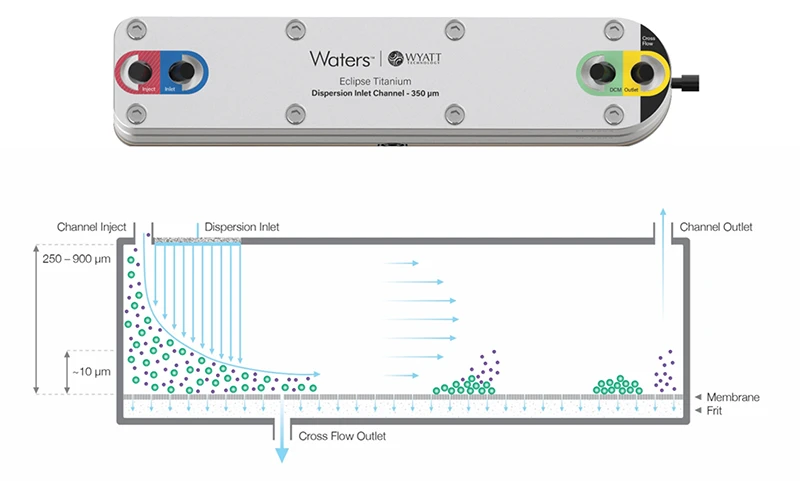
Focusing plays an important role in many AF4 separations, offering clear advantages for resolution and concentration. At the same time, not every application requires the full complexity of a focusing method. The dispersion-inlet channel provides an alternative that simplifies how key method functions are executed—reducing the number of steps involved while maintaining meaningful separation performance.
By introducing the sample through a controlled dispersion process, the channel streamlines method setup and minimizes conditions that can contribute to aggregation or sample loss, particularly for delicate systems. In its fixed-height titanium design, the dispersion-inlet channel also supports enhanced concentration through an improved DCM interface, enabling higher signal levels without adding operational complexity. The result is a more straightforward, robust path to FFF—one that makes it easier to start, easier to run, and easier to achieve consistent results when simplicity and reliability are the priority.
Ready to simplify your FFF workflow?
FFF has always delivered insight where other techniques fall short. What’s changed is how easily that power can now be put to work. By simplifying workflows, strengthening the hardware foundation, and integrating seamlessly with the LC systems labs already rely on, high-performance FFF becomes more approachable, more consistent, and more scalable. This is FFF designed for real labs—where speed, confidence, and reproducibility matter as much as capability. A simpler path doesn’t mean less performance. It means more teams can finally take full advantage of what FFF has to offer.
Discover how a more integrated, user-focused approach can help you move faster—from first run to routine results.
Already using FFF
Explore how guided workflows and fixed-height channel designs can reduce preparation time and improve run-to-run consistency. See the benefits of VISION 4 with Waters Arc and Arc Premier support.
Learn moreEvaluating FFF for the first time?
See how a simpler, more guided approach can make high-performance FFF practical for everyday lab use.
Request product infoReferences
1. J.C. Giddings, “A New Separation Concept Based on a Coupling of Concentration and Flow Nonuniformities”, Sep. Science, 1, 123 (1966).
2. Boye et al., “Collections from Nature Protocols” Nat Protoc, 19, 1 (2024).
3. https://online.uspnf.com/