
Bringing MALS to QC: Aligning with USP™ <1225>

What if adopting the DAWN™ multi-angle light scattering (MALS) photometer in QC labs were simpler than you think? The technology has matured well beyond its research origins, delivering reliable, high-accuracy measurements that map cleanly onto the method-validation expectations defined in USP <1225> and other evolving regulatory guidelines.
A USP <1225>-Guided Approach to MALS Method Validation
Bringing new technology into heavily regulated labs is not as easy as simply “wheeling in the instrument”. It requires proper method validation to ensure that analytical procedures are adequate for assessing the quality of pharmaceuticals. USP <1225> “Validation of Compendial Procedures” provides guidance to the industry on how to validate different types of analytical procedures.
This article explores how MALS enhances biologics QC workflows and outlines the steps for transferring MALS methods from R&D to QC, highlighting example experiments that address the analytical characteristics described in USP <1225>.
Meeting Regulatory Demands with MALS and Empower™ CDS Software
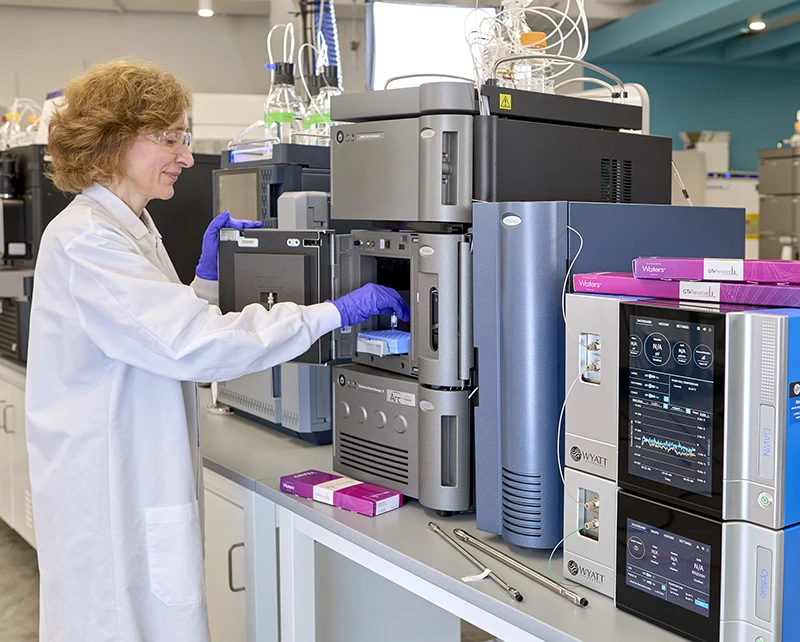
As biologics grow more complex and regulatory expectations increase, traditional quality control methods struggle to keep pace. Techniques such as size exclusion chromatography with UV absorbance detection (SEC-UV) alone can’t always confirm molecular identity, detect subtle aggregation, or verify the oligomeric state of high–molecular-weight species. To address this, regulatory agencies increasingly emphasize orthogonal strategies. For example, the EMA notes that “the purity of the drug substance and drug product is assessed by a combination of analytical procedures.”
Specific requirements vary by modality, but MALS satisfies several regulatory expectations by providing multiple critical quality attributes (CQAs) along with absolute molecular weight and size to better characterize aggregates and native oligomeric species.
Empower Chromatography Data System (CDS) Software further supports these needs as a compliance-ready platform, standardizing LC methods, instrument acquisition, data analysis, and reporting, while maintaining full audit trails and electronic records management. The custom field capability enables automation of routine calculations and reduces manual data export. These functions can also flag results outside pre-determined parameters.
White Paper
Read the white paper and explore the impact of cloud-based tools:
Navigating USP <1221> — What the New Guidelines Mean for Analytical LaboratoriesValidating Biopharma Methods Under USP <1225>
USP <1225> “Validation of Compendial Procedures” specifies that analytical methods must demonstrate accuracy, precision, specificity, detection limit, quantitation limit, linearity, range, and robustness. Each parameter requires carefully designed experiments using reference standards or well-characterized controls, with documentation of protocols, acceptance criteria, deviations, and statistical analyses. To make USP <1225> easier to navigate, the chart below provides a side-by-side view of each validation parameter’s definition with an example to help QC teams plan their validation strategy accordingly.
| Test per USP <1225> | Definition | Example determination with MALS |
|---|---|---|
| Accuracy | How close are the measured values to the true value. It is established by using reference standards, spiking known amounts, or comparing them with a well-characterized method. | Compare Mw accuracy to a known reference protein or polymer standard (e.g., NISTmAb RM 8671, USP polysaccharide molar mass standards) run under the same SEC conditions.
Application Note 1622 |
| Precision | The consistency or reproducibility of measurements when the method is repeated on the same sample (multiple aliquots). Precision can include repeatability (within a run) and intermediate precision (across days, operators, equipment). | Replicate injections of the same sample across multiple runs, days, and operators to check molecular-weight and mass% distribution. Instrument-to-instrument comparison is typically recommended.
Application Note 1620 Publication, NIST and USP |
| Specificity | The ability of the method to unequivocally assess the analyte in the presence of other components (impurities, excipients, matrix, degradation products). The analyte signal should not be affected by these extraneous substances. | SEC-MALS separation of known mixtures (e.g., monomer/dimer/aggregate) to confirm baseline resolution and distinct molar-mass traces. Reference materials such as NISTmAb or protein ladder standards can be used.
Application Note 1622 |
| Detection Limit | The lowest amount of analyte that can be detected (but not necessarily quantified) under the stated conditions. It establishes how sensitive the method is at the low end. | Dilution series of a well-characterized standard to find the minimum concentration giving a signal-to-noise ratio above the required threshold.
Publication, Tanvex Biopharma |
| Quantitation Limit | The lowest amount of analyte that can be quantified reliably with acceptable precision and accuracy. It is higher than the detection limit and must be validated. | Dilution series of a well-characterized standard to find the minimum concentration giving an acceptable precision level (typically RSD ≤10%) and accuracy for calculated Mw. Publication, BioMarin |
| Linearity and Range | Linearity: The method’s ability to produce responses proportional to analyte concentration over a defined span.
Range: The interval from the lowest to highest analyte concentrations for which the method is validated to provide acceptable accuracy, precision, and linearity. |
Measure the concentration-response relationship. Typically tested on the main concentration detector (such as UV and dRI). In viral-vector research, this can include empty/full ratio.
Publication |
Conclusion
Successfully transferring SEC-MALS methods to QC demands scientific rigor, regulatory alignment, and strategic planning. USP <1225> “Validation of Compendial Procedures” provides the framework for ensuring that analytical procedures are robust, reproducible, and suitable for assessing pharmaceutical quality.
Waters supports this transition with optimized methods, compliance-ready software solutions, and technical expertise, helping laboratories implement SEC-MALS in QC with confidence and compliance.