
High-speed, Low Volume Optimization of the Colloidal Stability of Antibody-Oligo Conjugates

Formulating antibody-oligonucleotide conjugates (AOCs) presents unique challenges: how do you balance stability and viscosity in these complex, high-potential therapeutics? High concentration AOCs maximize their therapeutic potential by combining the precision of oligonucleotides with the specificity of monoclonal antibodies (mAbs) to deliver potent gene therapies to the tissues where they’ll deliver the greatest benefit. This approach reduces manufacturing costs and allows subcutaneous delivery, improving both patient comfort and accessibility. However, traditional characterization methods fall short with AOCs due to their unique charge profiles, creating blind spots during formulation.

A First for Antibody-Oligoconjugates
Researchers at Avidity Biosciences, in collaboration with Waters|Wyatt, published a first-of-its-kind systematic comparison of a model AOC to its parent mAb, discovering key differences in the optimal formulations to increase stability and decrease viscosity. This investigation provided a clear evaluation of key intermolecular interactions. The AOC exhibited lower viscosity, lower aggregation propensity, and higher solubility when formulated in high pH and high salt, while the parental mAb preferred a low pH, low salt environment. Two key experiments helped the scientists determine why:
- Isoelectric point (pI) determination with the DynaPro™ ZetaStar™ Instrument to guide buffer selection that minimizes aggregation and precipitation
- Using the diffusion interaction parameter (kD) with the DynaPro™ Plate Reader to predict viscosity and aggregation risk
Determining pI in High Salt with Zeta Potential
AOCs often need higher salt concentrations in their formulation to be soluble. Standard methods of determining pI have an upper maximum salt concentration of about 50 mM, making it impossible to use them with AOCs. By measuring the zeta potential of the AOC with the DynaPro ZetaStar Instrument over a pH range, the researchers at Avidity were able to increase the salt concentration to 100 mM NaCl and still determine the AOC’s pI.
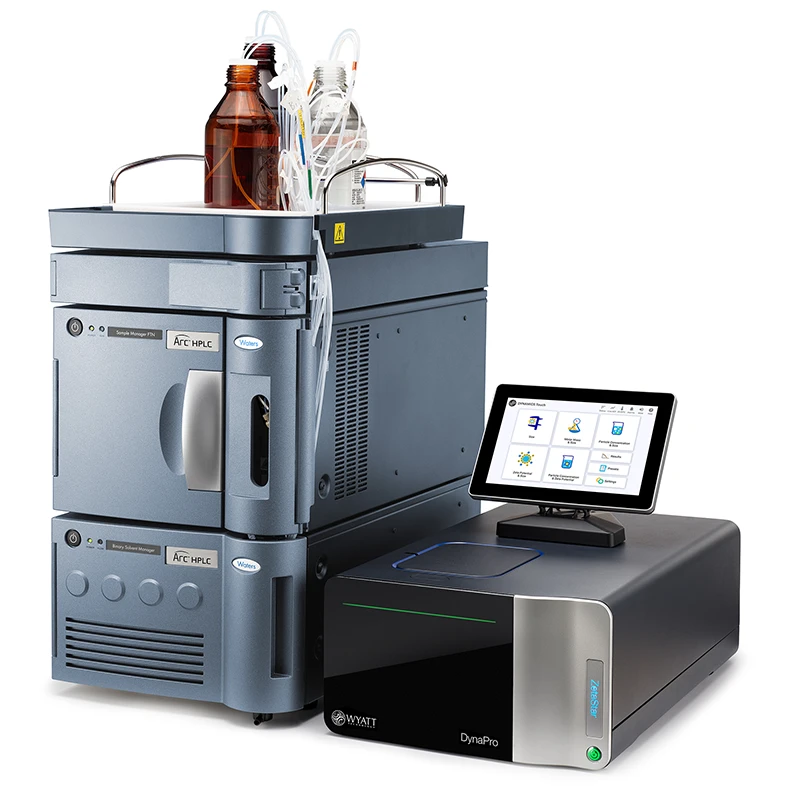
In this case, the pI of the AOC was ~5 while for the parental mAb it was ~9 – quite a significant change. The shift in pI after conjugation indicates that there are strong attractive forces between the negatively charged oligonucleotide and positively charged mAb, leading to aggregation and precipitation. Increasing the pH and using higher salt concentration to shield these charges should reduce the undesirable protein-protein interactions.
High Salt, High pH Reduces AOC Protein-Protein Interactions
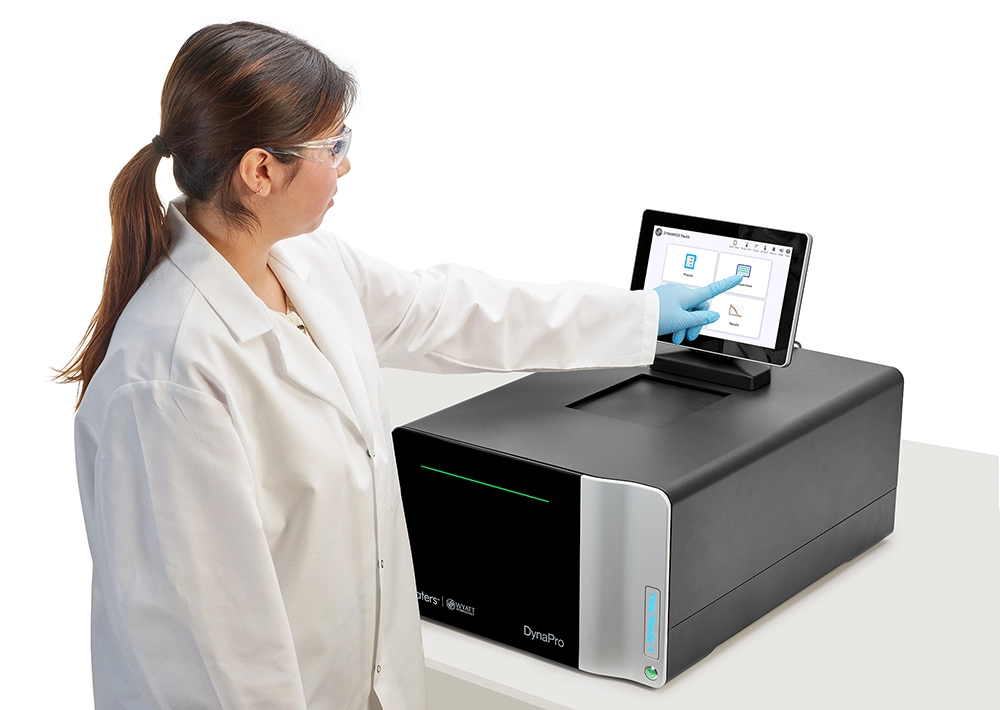
There are few techniques for measuring protein-protein interactions, a key indicator of colloidal stability, that are as high-throughput and use as little volume as dynamic light scattering (DLS). The diffusion interaction parameter (kD) indicates how diffusion rates of a particle changes depending on its concentration and is one method that is non-destructive and applicable to a wide variety of buffer conditions. The researchers at Avidity Biosciences used the DynaPro Plate Reader to measure kD of their mAb and AOC to identify optimal formulation conditions.
Higher kD values indicate more repulsive, or less attractive, intermolecular forces and mean a protein, or conjugate, is less likely to aggregate under the tested conditions. The Avidity mAb tended to have higher kD in low salt, acidic formulations while the AOC had higher kD in higher salt, alkaline conditions. The conditions with higher kD values for the AOC and mAb also had lower viscosities at high concentration >100 mg/mL.
The DynaPro ZetaStar and Plate Reader Instruments help researchers overcome formulation blind spots. A few features make them particularly good for early stage development:
- Low volume consumption
- High-throughput methods
- Easy-to use automation
AOC Formulation: Pioneering the Next Era of High-Potential Biopharmaceuticals
AOC formulation is not just an extension of mAb formulation— it’s a new frontier in biopharmaceutical development. With insights from zeta potential analysis and a deeper understanding of conjugate behavior, formulation scientists can design robust, scalable AOC products that meet the demands of modern therapeutics: higher stability, lower viscosity, and easier to manufacture. As research accelerates, easy-to-use tools from Waters|Wyatt can help you make AOC formulation a valuable cornerstone of next-generation drug development.
Ready to take the next step in AOC optimization?
Expand your understanding with these resources:
Featured Instrument:
DynaPro™ ZetaStar™
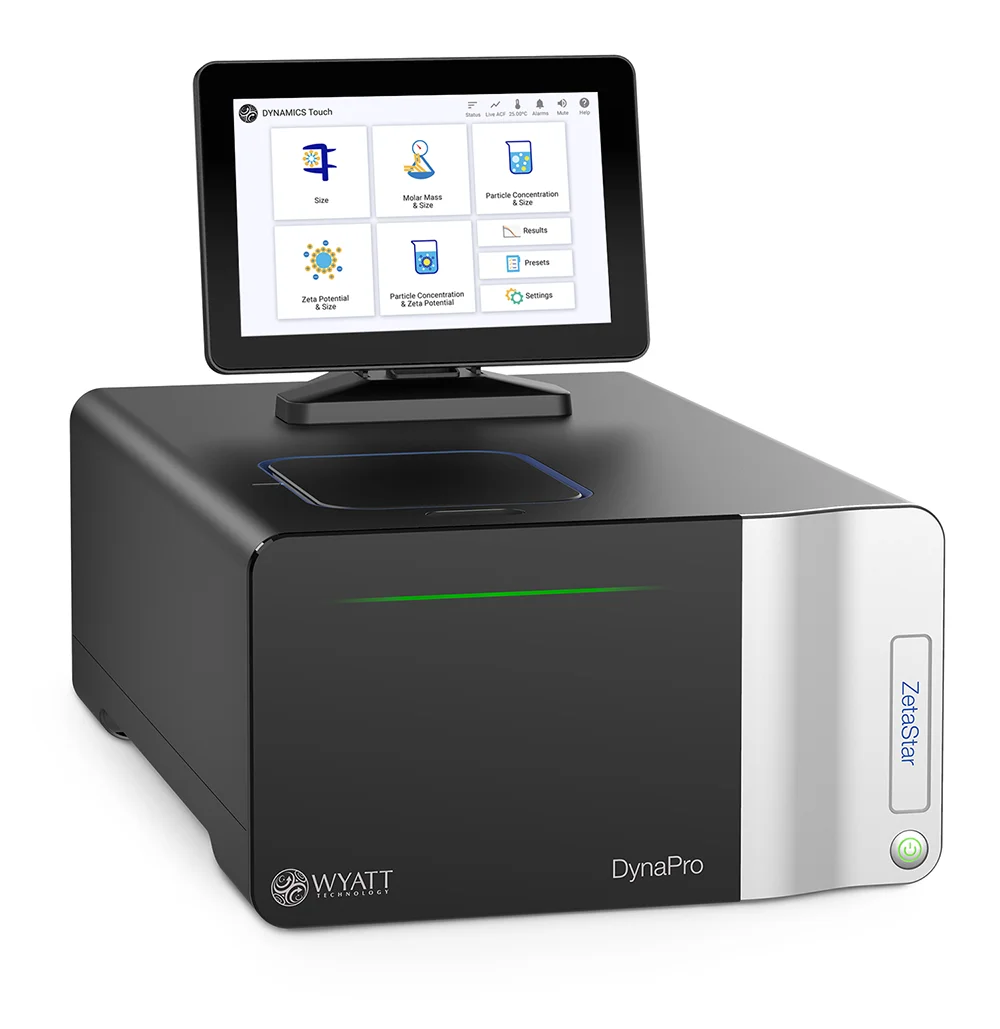
Fast & automated DLS/SLS and electrophoretic light scattering (ELS) instrument.