Table of contents
Request Quote
Click hereomniDAWN™
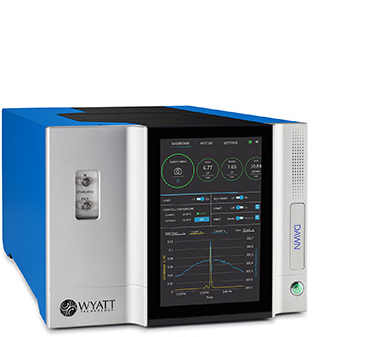
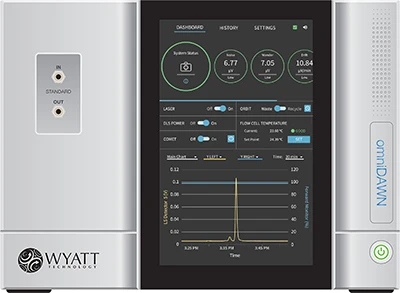
Purpose-built for UPLC™ and UHPLC, omniDAWN™ MALS photometer delivers absolute molecular weight and size determination at true high-performance speeds
True multi-angle light scattering (MALS) analysis shouldn’t force tradeoffs.
While some solutions struggle to keep pace with UPLC separations, omniDAWN MALS detector is purpose-built to operate at true UPLC and UHPLC speeds.
The result is uncompromised resolution, sensitivity, and data quality—delivering absolute molar mass and size information without slowing down your workflow or diluting performance.
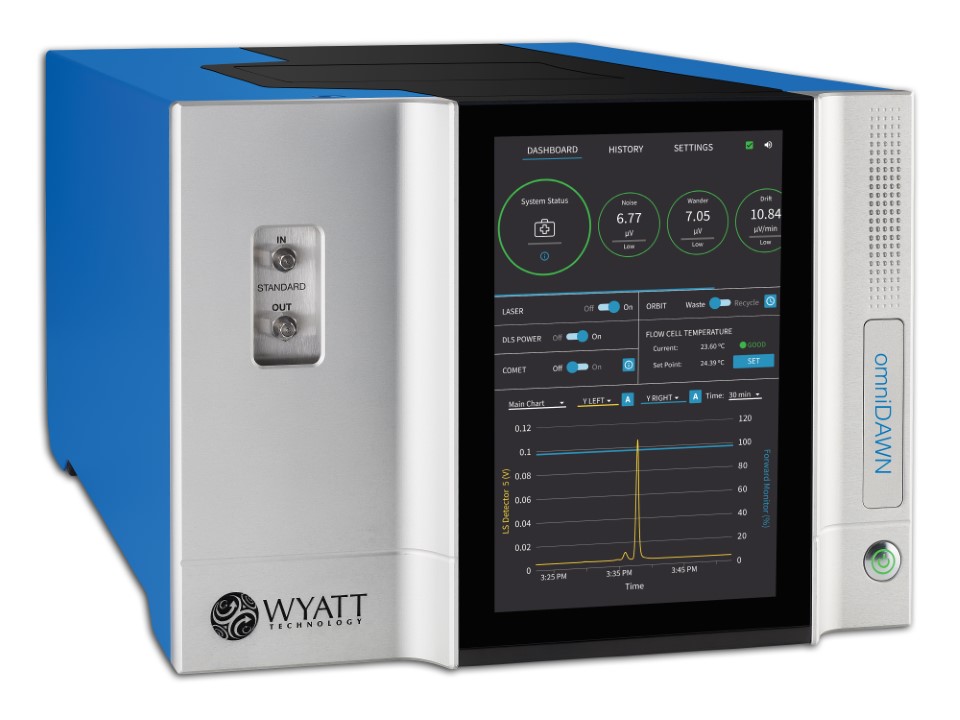
Features
Purpose-built for UPLC™ and UHPLC systems, the omniDAWN instrument is the premier multi-angle static light scattering (MALS) detector for absolute characterization of the molar mass and size of macromolecules and nanoparticles in solution. It offers the highest sensitivity, the widest range of molecular weight, size, and concentration, advanced analysis modules and implementation guides, and intelligent system health monitoring.
- Range and sensitivity for every application: Measures radii from 10 nm to 1 µm and molar mass from 200 Da to 1 GDa, using 18 optimally placed scattering angles and a flow cell designed to eliminate virtually all stray light.
- Advanced analysis: Dedicated analysis and implementation guides for conjugated peptides, antibody-drug conjugates, lipid nanoparticles, viral vectors, and polymer branching.
- Reliable results every time: Intelligent system monitoring combined with an integrated in situ ultrasonic cleaning module ensures consistent performance and confidence in your results.
How it works
Clear Answers for Every Macromolecular Characterization Need
The omniDAWN MALS photometer delivers absolute clarity for molecular and particle analysis. Using multi-angle light scattering (MALS), omniDAWN instruments measure absolute molar masses from a few hundred to hundreds of millions of Daltons and particle radii from 10 nm up to 500 nm.
MALS removes uncertainty associated with column calibration, molecular standards, and non ideal column interactions, delivering highly accurate and reproducible data, even for challenging samples such as ADCs, LNPs, viral vectors, and conjugated polymers.
Up to 4× faster runs, half the sample, and superior separation with UPLC
Connecting MALS to UPLC delivers three key advantages: up to 4× faster run times, using only half the sample, and sharper separations that reveal fragment peaks not discernible by HPLC, giving you speed and clarity in a single workflow.
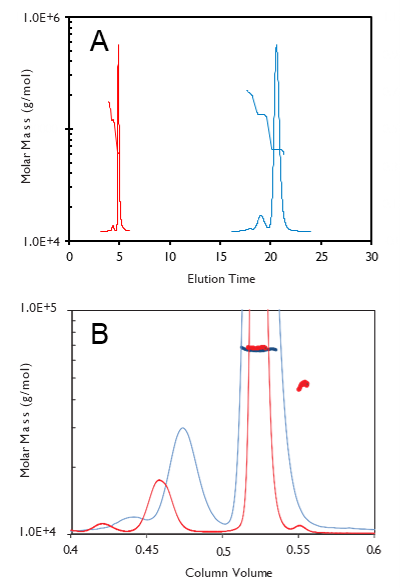
A) Achieve up to 4× faster LC-MALS runs with UPLC.
B) Achieve superior separation, revealing fragment peaks not discernible by HPLC.
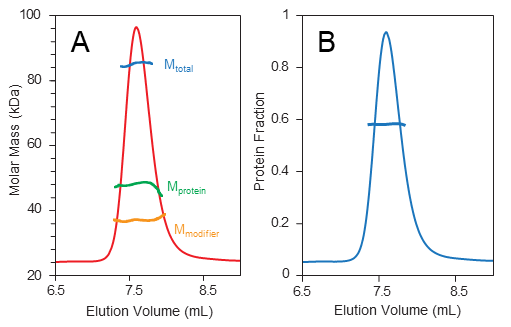
ASTRA software goes beyond measuring overall molecular weight by: A) uniquely resolving individual components to quantify protein and conjugated species and determine stoichiometry, and B) reporting the total protein fraction.
Advanced analysis for the most complex samples
Built on more than 40 years of light scattering innovation, ASTRA™ software makes it easy to characterize complex macromolecules and nanoparticles with confidence. By combining data from MALS, UV, and RI detectors, ASTRA delivers clear, reliable insight into complex therapeutics, revealing the size, composition, and overall makeup of the molecule in a single analysis. Dedicated workflows for ADCs, lipid nanoparticles (LNPs), and viral vectors simplify setup and interpretation, helping researchers obtain trusted answers faster.
Reliable Results Every Time
The System Ready Monitor continuously verifies optimal conditions and alerts you to any deviations with clear, actionable guidance. If issues arise, Real-Time Health indicators provide detailed diagnostics and step-by-step solutions to minimize downtime and maintain peak performance, while the integrated COMET™ ultrasonic device automates in situ cell cleaning.
Whether you are troubleshooting or preparing for your next run, the system keeps you in control and ensures consistent, reliable results every time.
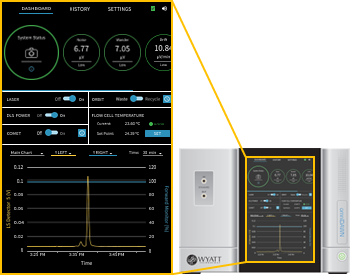
The System Ready Monitor continuously verifies optimal performance and displays the status on the front panel. If issues arise, it changes from green to yellow to red based on severity and provides real-time, actionable guidance to quickly restore peak system health.
Resources
Brochure
Curated Application Notes & Ebooks
- Ultimate Guide to Light Scattering Instruments
- Multi-Attribute Quantitation of Antibody-Drug Conjugates (ADCs) by LC-MALS
- Assessment of Biosimilarity in mAb-based Therapeutics Using SEC-MALS
- The Role of Multi-Angle Light Scattering in Biosimilar Characterization and Approval
- Identification of GLP-1 analog oligomeric states using SEC-MALS
- Multi-attribute quantification of LNP-mRNA therapeutics by FFF-MALS and DLS
- AAV critical quality attribute analysis by SEC-MALS
Theory
Software
Webinars
- Check out our latest webinars
- Light Scattering Theory and Applications:
Introduction to Multi-Angle and Dynamic Light Scattering: Applications in Biotherapeutics - Polysaccharide Vaccines:
Advances in Polyconjugate Vaccine Development: Leveraging SEC-MALS for Enhanced Quality Control and Efficacy - mRNA quality:
Comprehensive Chromatographic Assessment of Forced Degraded In Vitro Transcribed mRNA - Polymers:
Structural Characterization of Functional Polymers via Light Scattering and Differential Viscometry - LNPs and Liposomes:
Beyond Batch Methods: High Resolution Nucleic Acid and LNP Insights with Light Scattering Techniques - Viral Vectors:
Optimizing Development and Release Efficiency of Protein, AAV and LNP Therapies Using Multi-Attribute Quantification (MAQ) Light Scattering - Peptides & GLP-1RAs:
CQA Assessment of GLP-1 Agonist with DLS and SEC-MALS - ADCs, AOCs, and Conjugate Proteins:
Analysis of PCVs, AOCs, ADCs, and RNPs with Light Scattering